CoCo Lab
Computational Cognitive Neuroscience
of Brains and AI Systems Under Uncertainty
Yul HR Kang, MD, PhD




Mission | Research | PI | Teaching | Team | Contact
Openings
If you are interested in working with us, please feel free to get in touch!
News
- Aug 2025: Yeowon received a Poster Presentation Award from KSBNS for “Predictive Learning Induces Bayesian Cognitive Maps in the Hippocampus.”
- Jun 2025: Yul received a Best Human Rights Professor Award from the KAIST Graduate Student Council.
- Apr 2025: Yul gave a talk at Cosyne Workshop “Navigation Under Uncertainty.”
- Dec 2024: Yul received a KAIST Q-Day Education Award for the Computational Neuroscience course.
- Oct 2024: Our submission to the NeurIPS NeuroAI workshop, “Predictive Learning Induces Probabilistic Cognitive Maps,” led by Yeowon, received a Top 3 Student Paper Award.
- Mar 2024: Our very first Cosyne submission, “Uncertainty encoded in a recurrent neural network trained to predict visual input during navigation,” led by Yeowon, won a Cosyne Presenters Travel Grant.
Mission
Uncertainty seeds pain and joy.
We study how the brain and AI systems navigate uncertainty. This is where intelligence is most needed, yet least understood, perhaps due to its complexity.
To tackle this problem, we take a unique approach combining two traditions, hitherto largely separate: Bayesian and neural network modeling.
We test our models with behavioral experiments of our own and neural data from collaborators. With them, we aim to advance the foundational understanding of computational cognitive neuroscience and of brain disorders, including insomnia and mood disorders.
Ultimately, we hope to improve how we manage uncertainty where we can, and to offer consolation where we cannot—by showing that what appears suboptimal may, under cognitive constraints, be the best one can do.
Research
With excellent collaborators (below), we have shown that:
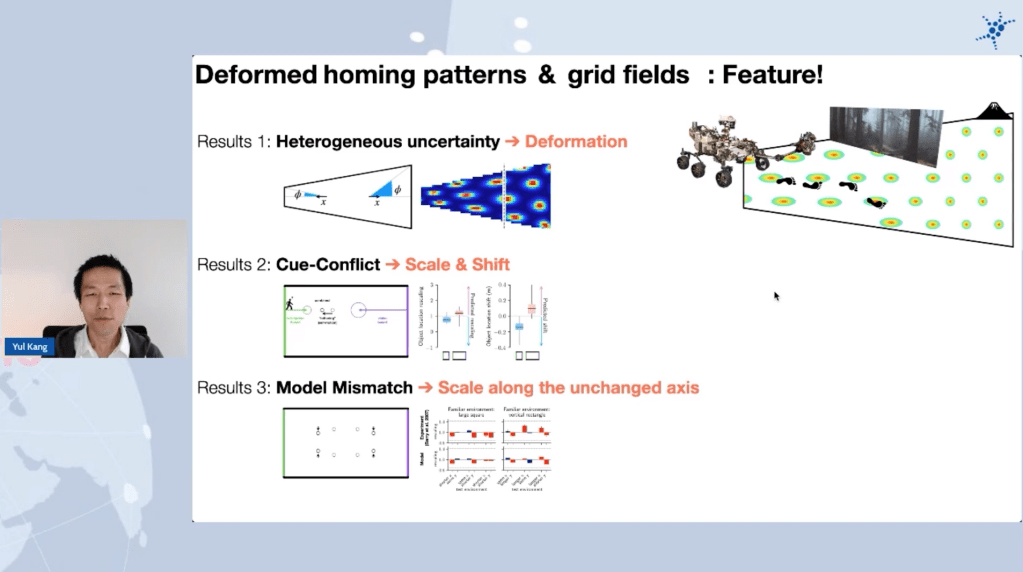
- Spatial navigation: grid fields (often called a “ruler in the brain”), which were thought to “deform” depending on the geometry of the environment, in fact represent uncertainty about the animal’s own location (Cosyne Presenters Travel Award; Bernstein Contributed Talk). Here we developed:
- a normative theory that jointly predicts the deformation in the neural representation as well as bias and variability in homing behavior.
- an ideal observer model that takes as input the video from the 1st-person perspective and egocentric motion, and outputs the posterior belief over the agent’s allocentric location, which allows it to be applied to any setup without handcrafted features, as demonstrated by our re-analysis of historical results.
- Episodic memory: memory of a unique episode is retained with a graded sense of uncertainty, which has not been considered quantitatively in the domain of episodic memory. We showed that not only is this uncertainty used in causal inference, as reflected in explicit choices, but also betrayed by gazes even after accounting for the explicit choices (CCN 2023).
- Dual-task: two decisions about one object cannot be made simultaneously; they are made one by one, and evidence for each accumulates in an interleaved fashion. We showed this by developing novel behavioral tasks & efficient drift-diffusion models, which fit the joint distribution of choices and reaction times (eLife 2021; Excellent Poster Award: Korean Association for Computational Neuroscience; Cosyne Contributed Talk).
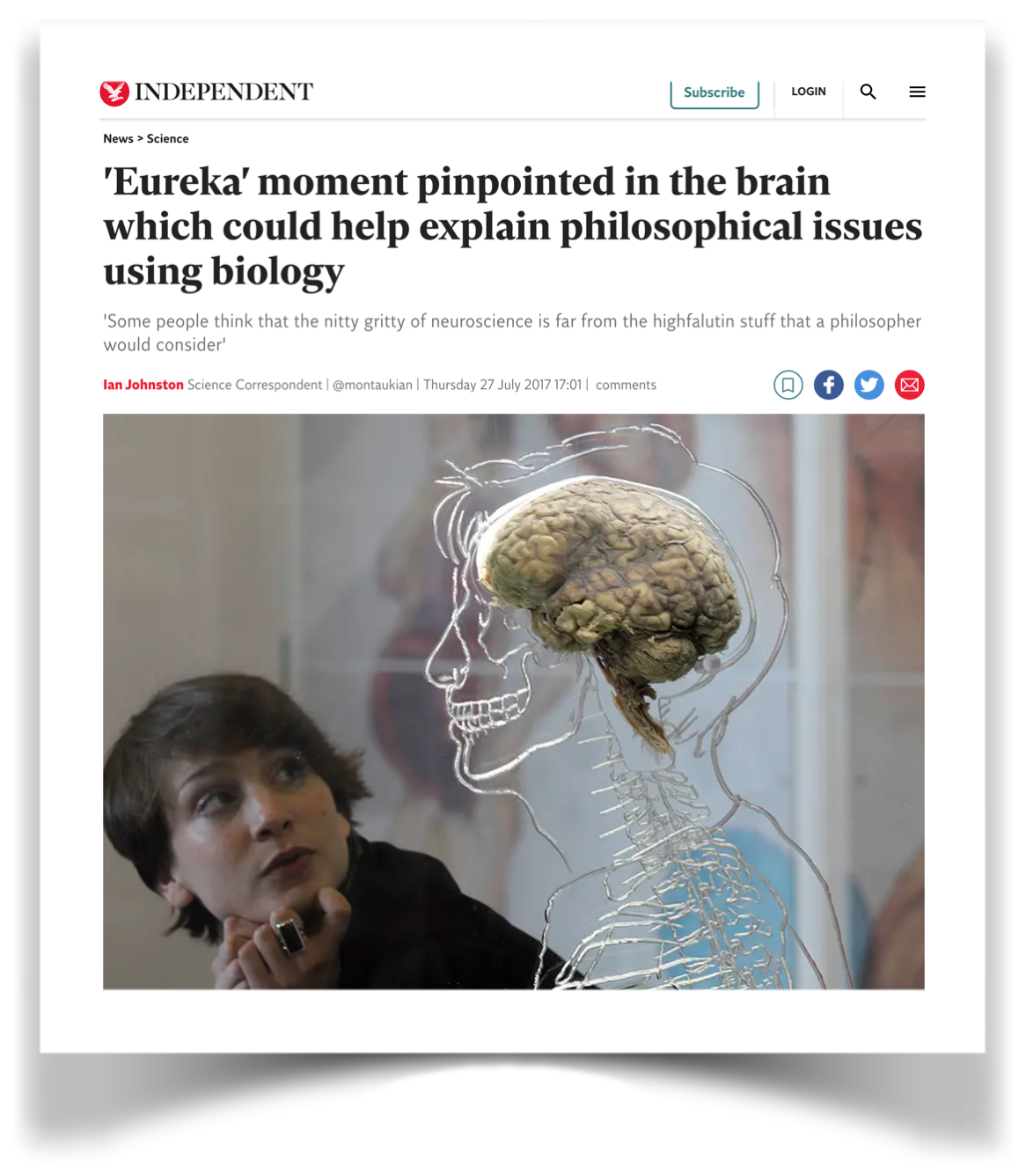
- Conscious awareness: people become aware that they have reached a decision when evidence for the decision is accumulated up to a threshold, which we showed by developing a novel behavioral task and analysis to predict and cross-validate the accuracy of the decision given the timing of the awareness using drift-diffusion models (Current Biology 2017; News piece in the Independent).
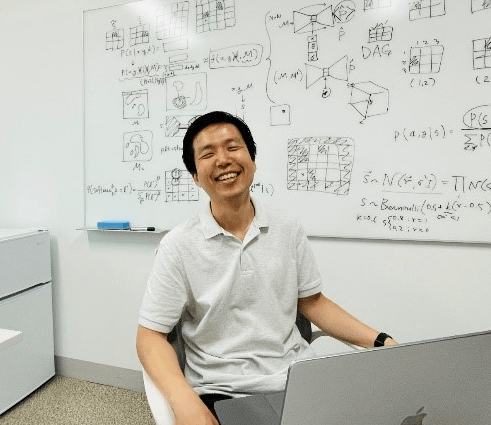
PI: Yul HR Kang, MD, PhD (강형률)
Education & Professional Appointments
- Affiliate Faculty Member (2025–), New York University
- Adjunct Professor (2024–), Graduate School of Data Science, Korea Advanced Institute of Science and Technology (KAIST)
- Assistant Professor (2023–), Department of Bio and Brain Engineering, KAIST
- Lecturer (2022–2023), Department of Biological and Experimental Psychology, Queen Mary University of London
- Junior Research Fellow (2019–2022), Wolfson College, University of Cambridge
- Postdoctoral Research Associate (2018–2022), Computational and Biological Learning Lab, Department of Engineering, University of Cambridge (Máté Lengyel group)
- PhD in Neuroscience (2018), Columbia University (Michael Shadlen lab; Supported by the Vision Training Grant from the National Eye Institute)
- MD, Seoul National University, South Korea
- Summer/Winter Schools for International Olympiad in Informatics, South Korea
Collaborators
- Máté Lengyel (University of Cambridge)
- Daniel Wolpert (Columbia University)
- Michael Shadlen (Columbia University)
- Gergely Csibra (Central European University)
- Guifen Chen (QMUL)
- Hugo Spiers (UCL)
Teaching
- BiS.49900B/DS.59993-002 AI Models of the Brain (Fall 2025–)
- BiS.42007/DS.50013 Computational Neuroscience (Spring 2025–)
- 2024 KAIST Q-Day Education Award
- BiS.89901 AI in Psychiatry (Spring/Fall 2025–)
- 2025 KAIST Education Innovation Award
- BiS800/DS801 Computational Psychiatry (Fall 2024)




2023–current (c) CoCo Lab
 CoCo Lab